The Story of Stuff

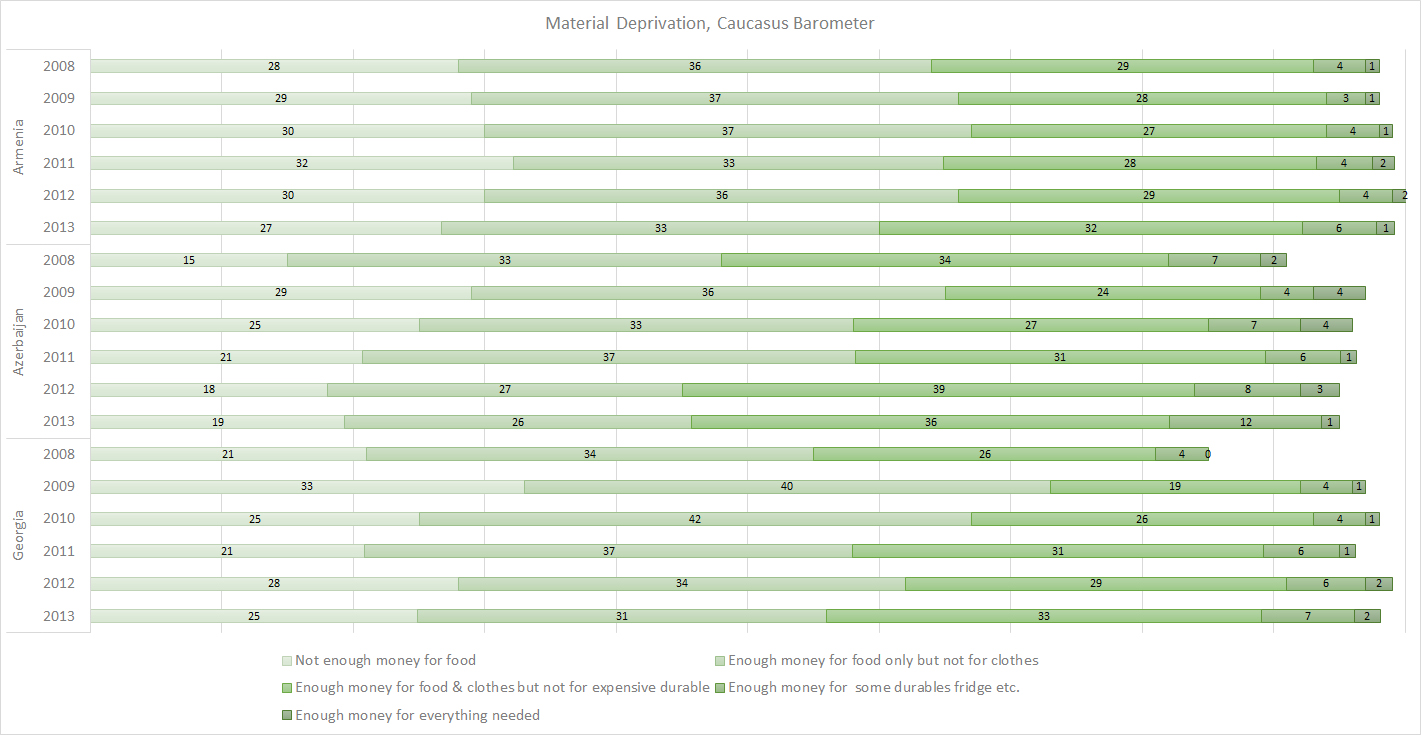
I’ve written before on consumption in the Caucasus, but here’s a 2012 update.

flickr

Any interesting ownership differences? Azerbaijanis like A/C, I guess.

flickr

No major differences here, but looks like Armenians love their phones!

flickr

People bought this stuff pretty recently.

I admit, this isn’t the most interesting analysis, but because it is so difficult to measure wealth in the Caucasus, I think looking at consumption habits is a good way to get a sense of how people are doing economically.

Regional and gender differences in Internet activities in Armenia, Azerbaijan, and Georgia

A recent RFERL report about social networking site use in rural Azerbaijan got me thinking about doing a blog post about regional differences in Internet activities in the Caucasus. (And whenever we’re talking about Internet and Azerbaijan, gender needs to be looked at as well.)

I have a forthcoming paper in the Journal of Communication that looks at the relative influence of demographics (gender, region, age, education, wealth, English language skill) and device (mobile or PC or both) on Internet activities in Armenia.

Here’s the abstract:
Digital inequality can take many forms. Four studied here are access to Internet, use of different devices, extent of usage, and engagement in different Internet activities. However, it is not clear whether sociodemographic factors, or devices, are more influential in usage and activities. Results from an unfamiliar context show that there are significant sociodemographic influences on access, device, usage and activities, and differences in activities by device type and usage. While sociodemographic differences are more influential, device type can increase likelihood of use for some “capital enhancing” activities, but only for a computer. Thus, although mobile Internet is available for those on the wrong side of the digital divide, these users do not engage in many activities, decreasing potential benefits.

Post on regional differences in Internet
SNS use

Anyway, along these lines, here are some 2012 Caucasus Barometer analyses (I only look at “capital enhancing” activities here as well).

am

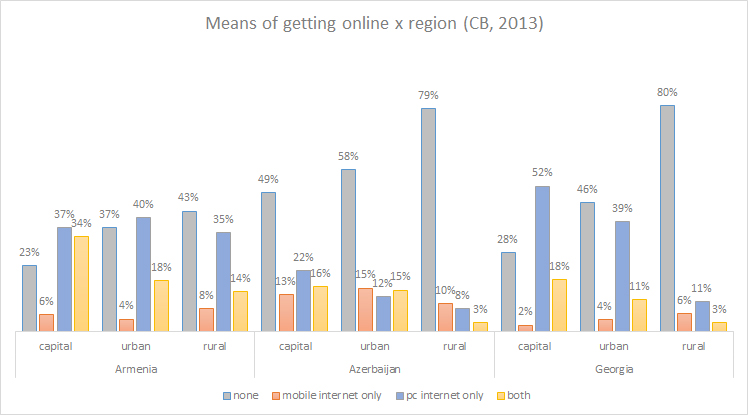
In Armenia, 50% of users are on social networking sites, regardless of region. Skype is much more popular in regional cities and rural areas, and online news is most popular in Yerevan. Notably, 18% of all rural Armenians use social networking sites. 22% of all rural Armenians use Skype.

az

In Azerbaijan, there is more variance between regions. Over half of all users, regardless of region, are on social networking sites; and the percentages of users of the other activities is fairly consistent between regions. However, there are few rural Azerbaijanis online.

ge

In Georgia, over two-thirds of users, regardless of region, are on social networking sites. Non-Tbilisi Georgians are less likely to read online news. 17% of rural Georgians are on a social networking site.

In terms of gender and activities, there are also some interesting differences.

gender

In Armenia and Georgia there are not many differences between men and women in their Internet activities. But in Azerbaijan, the differences are notable. (More on this here.)

Atheism in the Caucasus

Atheism in the Former Soviet Union is a complicated subject. During the Soviet period, everyone was encouraged to be atheist, but what about now? While it is difficult to ask people about their religion, asking them about their attitudes toward particular religions (or lack there of) IS possible.

First people were asked how often they thought that they came in contact with an atheist.

Interestingly, Azerbaijan seems to have the “most” atheists, although the 22% “don’t know” is telling. Nonetheless, 10% daily contact is a lot compared to Armenia and Georgia.

family

But what about an atheist joining the family?

contact

Again, Azerbaijanis seem to be the most tolerant of an atheist in the family.

(All from 2012 Caucasus Barometer).

Armenian, Azerbaijani, and Georgian Internet user types

What are the typical Internet users in the Caucasus?

Using factor analysis (a technique where you see what things are related to other things), I’ve created some Caucasus Internet user types. I then used regression to see what demographic characteristics made it more or less likely for someone to be in a particular user type. (All 2012 Caucasus Barometer.)

Armenian Internet user types

Type 1: interactive entertainment
These users engage in a wide variety of activities: forums, blogs, shopping, dating sites, games, download music/videos, IM, skype, SNS

And who are they? They’re online frequently, they’re wealthier, they’re better educated, they’re more urban, they aren’t as proficient in English, and they’re younger.

Type 2: business only
These users engage in email, SNS, not downloading music/video, not news

They’re younger, they’re proficient in English, they’re online frequently, they’re better educated, they’re not as wealthy, they’re more urban, and they’re male.

Type 3: info seekers
These users search for info, news, not games, not SNS

They’re better educated, they’re urban, they’re wealthier, and they have good English.

Type 4: chatters
IM, not skype

They’re rural, they’re male and they’re proficient in English.

Azerbaijani Internet user types

Type 1: interactive entertainment
These users are on blogs, forums, shopping, skype, IM

They’re online more frequently, they’re better educated, they’re more likely to be proficient in English, and they’re not as wealthy.

Type 2: entertainment
download music/videos, online games, dating sites

They’re less educated, they’re less proficient in English, they’re less wealthy, and they’re younger.

Type 3: info seekers
news, search for info, not SNS

They’re older, they’re better educated, they’re not online as frequently.

Georgian Internet user types

Georgian Internet user types:

Type 1: looking for love?
dating sites, skype

They’re wealthier, they’re older, they’re men, and they’re less educated.

Type 2: engaged
blogs, forums, SNS

They’re younger, they’re online frequently, they’re better educated, they’re female, they’re proficient in English.

Type 3: gamers
games, not skype, download music/videos

They’re younger, they’re not online as much, they’re less educated, they’re younger, they have good English.

Type 4: info seekers
search for info, news, not SNS

They’re older, more urban, highly educated, profcieint in English.

Type 5: business only
email, not downloading music/video, not news

They’re highly educated, they’re urban, they’re proficient in English, they’re older.

So what to conclude from this? Well, I’m happy that there are enough users now that I can actually see some differences! But in terms of a takeaway, it gives us a sense of who is online and what they are doing. It is all too easy to assume that “Internet users” are a monolith and that they’re all doing the same things online. This demonstrates that in fact there are differences between users within the Caucasus countries.

Age distributions on Internet and Social Networking Sites in Armenia, Azerbaijan, and Georgia

I had a request via Twitter for age analysis on social media use in the Caucasus. Ask and you shall receive.

But first, let’s start with Internet frequency.

Certainly, there are a lot more younger people online than there are older people in all 3 countries.

Interestingly, two-thirds of Armenian 18-24 year olds are online daily and only 13% of that age group aren’t online at all. Nearly half of 25-34 year old Armenians are online daily as well, but a third of that age group aren’t online at all. In Georgia it is similar with 61% of 18-24 year olds online daily and 11% never online. 43% of 25-34 year old Georgians are online daily and a little over a quarter are never online. Nearly all Georgians over 65 are not online, while in Armenia only 89% of that age group are not online. Ura to those Tatiks and papiks!

am

ge

az

But then there is Azerbaijan. Over half of 18-24 year olds in Azerbaijan aren’t online. 60% of 25-34 year olds aren’t online. And pretty low percentages in the older age categories are online. But, as always with Azerbaijan, you have to look at gender. So, here are the breakdowns for the 18-24 and 25-34 categories where you can see tremendous gender differences.

18-24

25-34

Social networking site use is quite popular in all three countries, but let’s examine the age distributions.

In Armenia, 63% of 18-24 year olds are on a social networking site and 44% of 25-34 year olds are. In Georgia 72% of 18-24 year olds are on a social networking site and 58% of 25-34 year olds are. Wow! Then we come to Azerbaijan where only 28% of 18-24 year olds and 23% of 25-34 year olds are on a social networking site. Again, the gender dimension certainly is an issue here.

am

ge

az

The website socialbakers.com has age distribution information for Facebook for every country. I don’t put a lot of weight into it, but I also did these pie charts to resemble socialbakers’, as that was what was requested via Twitter.

am

sb

az

sb

ge

sb

Protest attitudes in the Caucasus

Attitudes toward protest is one of my favorite Caucasus Barometer questions.

(Sarah Kendzior and I wrote a piece centered around this measure in 2012).

It is an interesting way to ask a question in a vignette format.

People are asked which statement they agree with and degree.

* Very much agree: People should participate in protest actions against the government, as this shows the government that the people are in charge.
* Agree: People should participate in protest actions against the government, as this shows the government that the people are in charge.
* Neither
* Agree: People should not participate in protest actions against the government, as it threatens stability in our country.
* Very much agree: People should not participate in protest actions against the government, as it threatens stability in our country.
* Don’t know

And with all of the exciting events in the Caucasus recently I was curious as to how people feel. And the analysis did not disappoint.

The collapsed analysis is a bit easier to follow. Two-thirds of Armenians think that it is okay to protest. 20% think it is not okay.
In Georgia, a little over half think that it is okay to protest, 17% think it is not okay.
And then Azerbaijan – 29% think it is okay and 43% do not think that it is okay.

protest collapsed

And non-collapsed is here.

collapsed

What are Armenians, Azerbaijanis, and Georgians doing online?

This demonstrates the percent of Internet users and percent from the total adult population that are engaging in particular online activities. To see more on general Internet, check this out.

This year there was no separation of Facebook and Odnoklassniki. I am under the impression,  however, that Facebook has sort of taken over.
armactivities

azactivities

Music and videos seem to be especially popular in Azerbaijan.

geactivities

Most Georgian Internet users are on a social networking site.


Facebookistan.am, Facebookistan.az, Facebookistan.ge in 2012

fb

This is an update to this post about 2011. 2012 overall Internet use here.

All data is from the Caucasus Barometer.

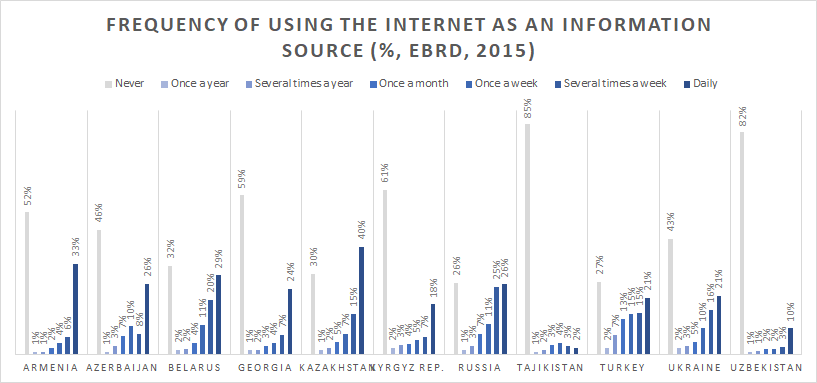
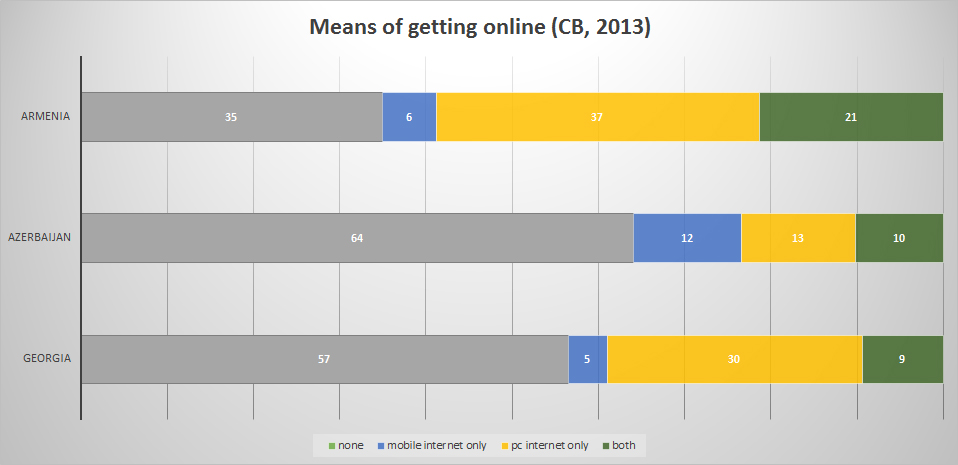
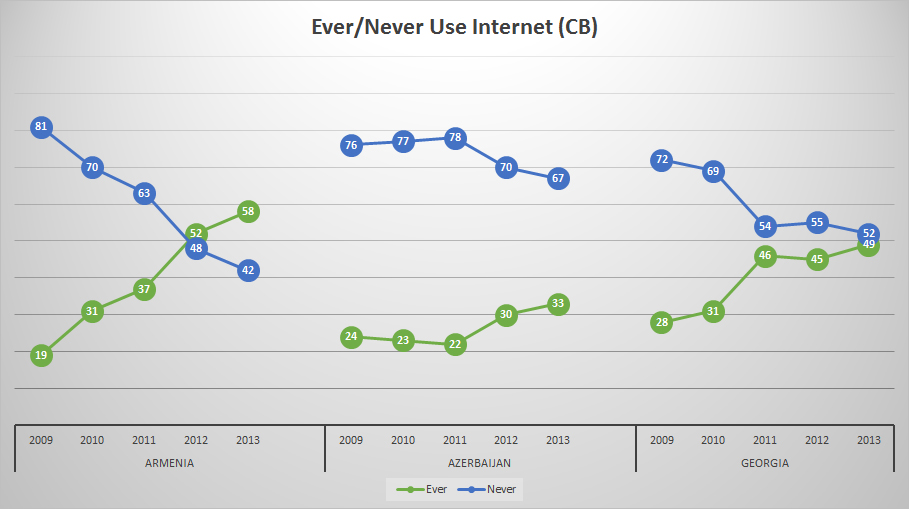
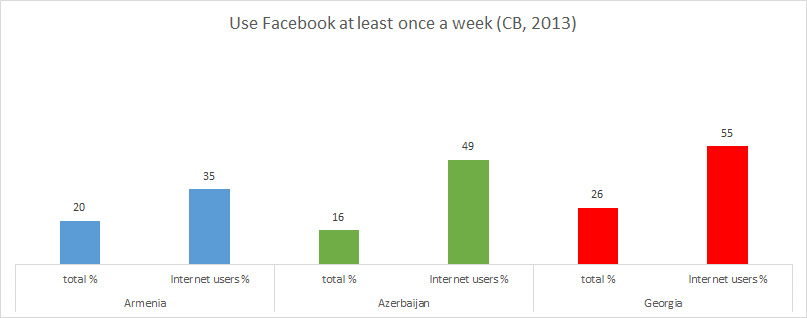
We know that a larger percentage of Armenians (52%) and Georgians (43%) are online than Azerbaijanis (27%) and weekly or more often adult Internet users are 43% of Armenians, 33% of Georgians, and 19% of Azerbaijanis.

Armenia has 3,100,236 people, Azerbaijan 9,168,000 people, and Georgia 4,486,000 people – but that’s total population, we need to look at just adults (since that’s the data we have about Internet use – I fully acknowledge that teenagers are online and may be using social media). According to the World Bank, 20% of Armenians, 21% of Azerbaijanis, and 17% of Georgians are ages 0-14.

So, let’s take them out of the equation – (that’s 620,047 Armenians, 1,925,280 Azerbaijanis, and 762,620 Georgians) – and you have “adult” populations of 2,480,189 AM, 7,242,720 AZ, and 3,723,380 GE. So raw weekly or daily Internet users would be:

744,057 in 2011 and 1,289,698 in 2012 Armenia
941,554 in 2011 and 1,376,117 in 2012 Azerbaijan
1,042,546 in 2011 and 1,228,715 in 2012 Georgia

Thus in 2012, there are about 1.2-1.4 million weekly or daily Internet users in each country, with Azerbaijan having the most in raw numbers, despite the lowest percentage.

map_caucasus

In 2011, 6% of Armenians, 7% of Azerbaijanis, and 9% of Georgians (ADULTS) were on Facebook (let’s leave Odnoklassniki out of this for now). In 2012, 27% of Armenians, 13% of Azerbaijanis, and 30% of Georgians were on a social networking site.

Raw numbers then would be:

148,811 in 2011 and 669,651 in 2012 in Armenia
506,990 in 2011 and 941,554 in 2012 in Azerbaijan
335,104 in 2011 and 1,117,014 in 2012 in Georgia

map_caucasus

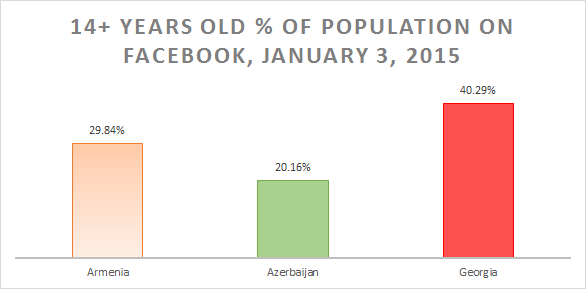
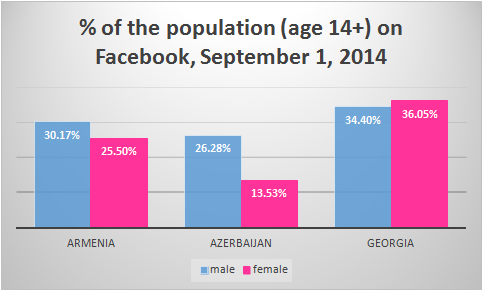
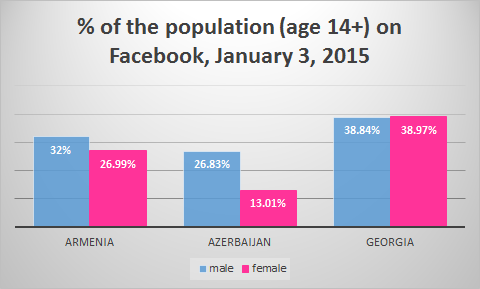
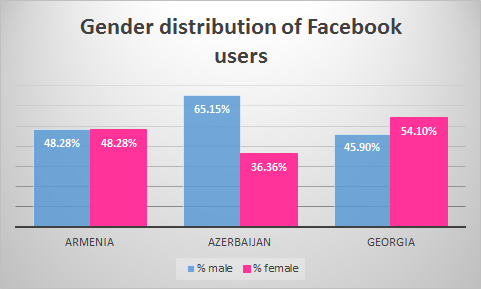
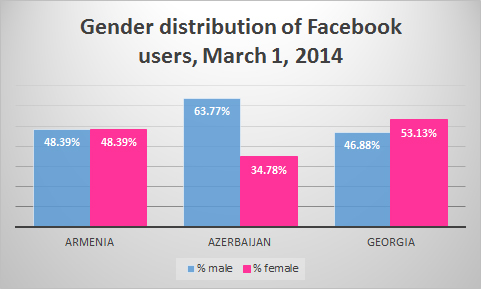
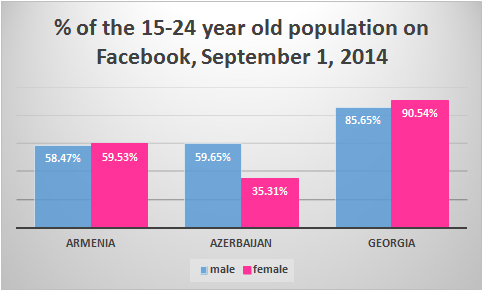
Socialbakers.com is a website that gives Facebook statistics. I’m not very comfortable using it because of its lack of transparency and because we don’t know where they get any of their data, but let’s see what they say.

ARMENIA
Total Facebook Users     395340 – I have 669,651 adults, so this seems off (although Odnoklassniki could be a factor)
Position in the list     112
Penetration of population     13.32% – I have 27% of adults
Penetration of online population     29.06% – I have 53% of adults

AZERBAIJAN
Total Facebook Users     1013080 – I have 941,554 adults, so this seems reasonable
Position in the list     82
Penetration of population     12.20% – I have 13% of adults, so this seems a little low for total population
Penetration of online population     23.97%I have 50% of adults, so this seems really off

GEORGIA
Total Facebook Users     969840 — 1,117,014 adults, so this seems fairly close
Position in the list     85
Penetration of population     20.95% — I have 30% of adults, so this is off
Penetration of online population     82.84% – I have 70% of adults, so this seems okay

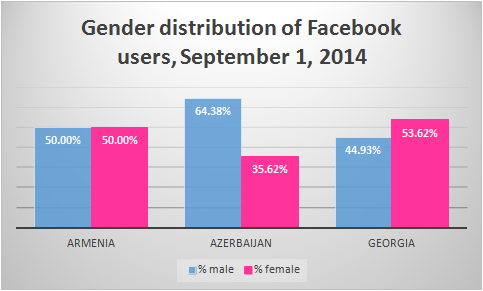
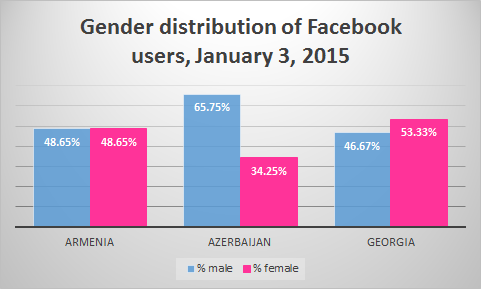
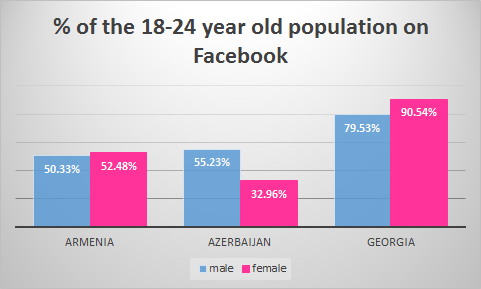
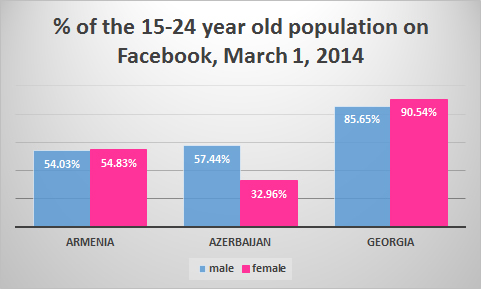
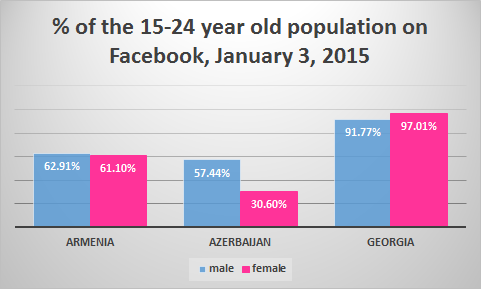
In the future I’ll look at socialbaker’s gender and age breakdown and see if it matches with what comes from the Caucasus Barometer.

(This is a copy and paste from what I wrote about 2011, but I wrote it in winter 2012.)

Okay, so back to my original point — I’ve noticed that the Azerbaijani Facebook and Twitter worlds is substantially more active than the Armenian one. (I acknowledge that I’m not up on what is going on in Georgia, but for reasons explained below, you’ll see that it is probably similar to Armenia). Why is this?

1. The raw numbers noted above — a lot more Azerbaijanis are on Facebook than Armenians. (I’m going to leave these countries’ diasporas out of this, but for what it’s worth, I feel like the Azerbaijani diaspora engages with Republic of Azerbaijan citizens more than Armenian diaspora do with Republic of Armenia citizens).
2. Because of the lack of free expression and assembly in Azerbaijan, most political discussion takes place on Facebook. Armenians can do this fairly freely in cafes or homes. Similarly, Armenians can organize and be political active in ways that Azerbaijanis cannot.
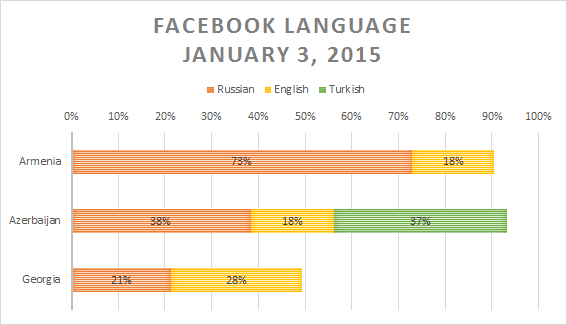
3. Language is a big part of this. As I wrote before, users of the Azerbaijani language are at a serious advantage over users of Armenian or Georgian because Azerbaijani uses the Latin script. This is also a special concern when it comes to Twitter and even more so when it comes to mobile phones (only the most recent Android OS has Armenian and Georgian, iPhone has it, but the others? No way). But my overall point is that there are barriers to Armenians and Georgians using these sites.
4. This is entirely speculative, but I get the sense that Bakuvians are just way more wired than Yerevantsis are. The Baku social media scene, beyond politics, is always jumpin’! There are a ton of Azerbaijani Instagrammers, Pinteresters, and other social media platform users. I just don’t see that same sort of scene in Yerevan. Yes, there is a bit of a FourSquare scene and of course people use these social media sites, but not to the extent that I see in Azerbaijan. (Although this may be a result of the sheer numbers!!)

I’m sure there are other reasons, and I’d love to hear comments…